Saturday, July 18, 2015

Wings of America


I am on vacation with my family in Gatlinburg, Tennessee. We went to Dollywood in Pigeon Forge where we saw a live show called "Wings of America." They do this show several times a day, with birds that cannot be released into the wild.This is a link to a website about how to help birds.

American Eagle Foundation


Tecumseh is the name of the Golden Eagle  in the picture above.
Tecumseh was hatched in a zoo and can't be released into the wild.


America is the name of the Bald Eagle in the picture above.
America was relocated for a re-population project. Shortly after he was released in Tennessee he got shot in the left wing in Michigan. Due to his wing injury he can't fly, so he couldn't get released into the wild.


Bonita is the name of the Crested Caracara in the picture above.
Bonita also got shot in the wing and she recovered from it, but still couldn't be released into the wild.

Cujo is the Black Vulture in the picture above.
Cujo wasn't afraid of humans when he was found and they think that he was raised by humans and then later when he got older they released him. Since he isn't afraid of humans he couldn't be released.

Tuck is the African Pied Crow in the picture above.
He was approximately six months old when they got him and they trained him to take donations and put them in the donation box at the end of the show. He only takes bills. If you give him coins he will swallow them whole.

Mikie is the name of  the the Harris' Hawk in the picture above . He was hatched
at the American Eagle Foundation and was raised by Golden Eagles
as an experiment, so he thinks he is a Golden Eagle.

Jesse is the name of  the Red-Tailed Hawk in the picture above. She was hatched and raised,
so she is used to humans.

Poe is the name of the Northern Raven in the picture above. She got
a wing  injury and cant fly. She also wasn't afraid of humans and thinks she is one of us

Golden Eagle -Tecumseh during the show


Bald Eagle - America during the show

Wednesday, July 1, 2015

Black Cochins

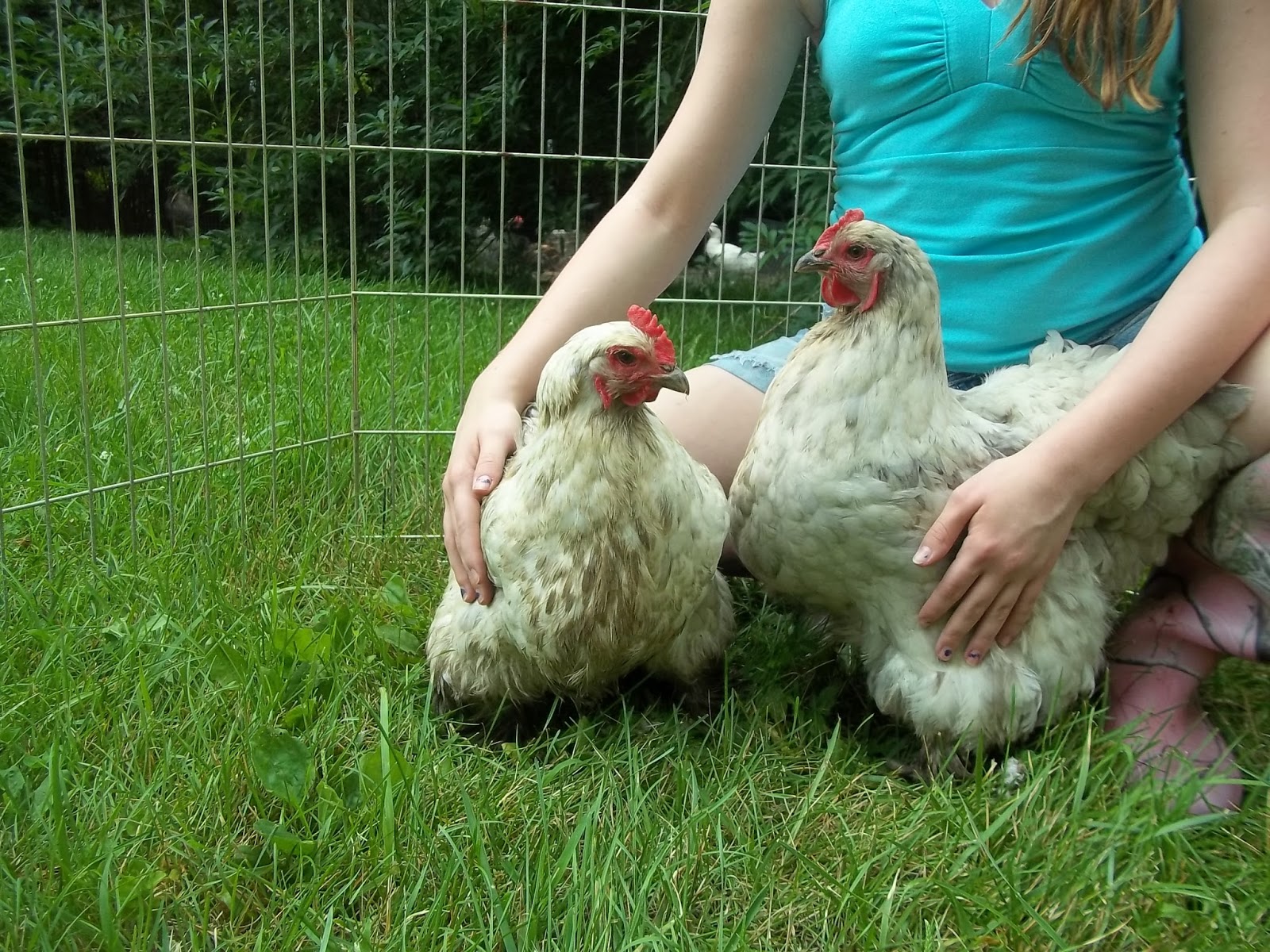
My older sister, Kayley, was going to show her Black Cochin chickens at the fair this year. She completed her project, but couldn't bring them to the fair.  She has a male named Twilight and a female named Stormfly.


Twilight and Stomfly

The book American Standed of Perfection says they should have a single comb with 5 rounded points and bright, clear eyes. Females should be round with soft, fluffy feathers (balls of fluff and feathers) and males should be broad and big.  They both have feathers covering their legs and 3 outer toes.  They also both have large capes and tails so big that they collide, hiding the back. Females should be about 9 lbs and males about 11 lbs.


black cochin chick


Cochins are very good pet chickens. They sit in your lap like a cat and are very ornamental. "Black cochins have a beatiful green gleam on their feathers and an intelligent shine in their eyes," says Kayley. They are also very friendly, calm, and quiet.  The roosters are not violent, only skittish. Although they aren't great layers,with medium size eggs, they are great mothers and can foster other chickens and even ducks. They are often broody.

Cochins can be black, blue, or splash.  By breeding two blue cochins you can get blue, black, or splash offspring. By breeding a splash cochin with a blue or black cochin, you can add color to the feathering.  My sister has a pair of black and a pair of blue cochins. She also has two female splash cochins.  They are very dirty right now because we have had a lot of rain, so they are not in show condition.


blue cochin hen - she is broody right now - her name is Blue


 splash cochin hen - she is broody right now - her name is Fred

Fluffkins and Blue - blue cochins


Dave and Fred - splash cochin hens - when they were little we thought that they were males


Cochins are in the Asiatic class and originated in China.  They were reconized for their "prettiness" and started " fancy"  poultry like we know it today. 

I think that my sister's Black Cochins are nice and pretty birds.  Stormfly dosen't like it when she is on a nest and you take the eggs from underneath her.  When you do reach under her to take the eggs, she makes weird noises.


Dave and Fred as chicks

Blue as a chick

Fluffkins as a chick

Monday, June 22, 2015

Duck Showmanship

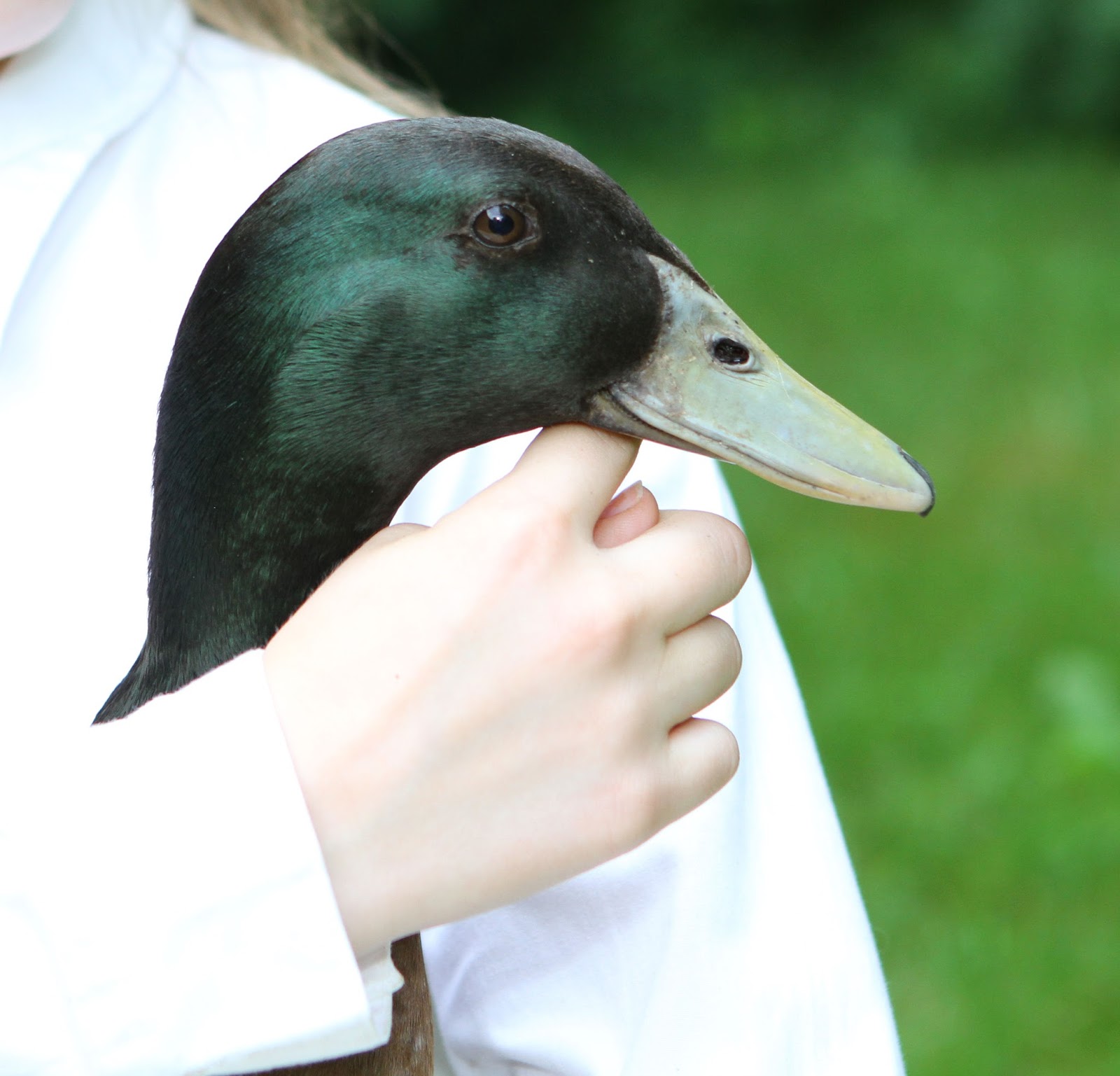
No one is going to be allowed to bring thier ducks, chickens, turkeys, and geese to the fair this year. I decided to do a post on how to show a duck. These pictures are of a khaki campbell drake. Khaki campbells are part runner, so they have more of an upright position when standing.
 
When showing ducks at the fair you should be dressed in a long-sleeved white dress shirt or a white lab coat and blue jeans. You should be neat and clean and remember to smile. You should also let your duck take a bath a few hours before the show. Put some olive oil on a cloth and wipe it on the bill, legs, and feet to make them shiny.


To Begin

 
Put the duck in an alert position on the table.


You pick the duck up with a hand under and on top.
There will be other pictures on how to have the hand that is under the duck.


To put the duck's head up in an alert position take one finger and put it under the
head and lift up.


Parts of the duck


Head


eye


nostril


bill and the bean
( the bean is the black at the end of the bill )


throat


neck


ear
( behind the eye )


cape


saddle


drake feathers
( only males have them )


tail


fluff


web


toe


shank


foot


primary feathers (for flight)


secondary feathers (for flight, shorter and broader than the primaries)


covert feathers
 (they protect the larger feathers by covering the quill, they insulate the bird, and they smooth the airflow over the body during flight)


wing


How To Show Different Sections
 
flip the duck sideways but not upsidedown. The tail should nicely unfold by it's self


To show the underside of the wing you put the duck's head between your arm and body and pull
the wing out and up.


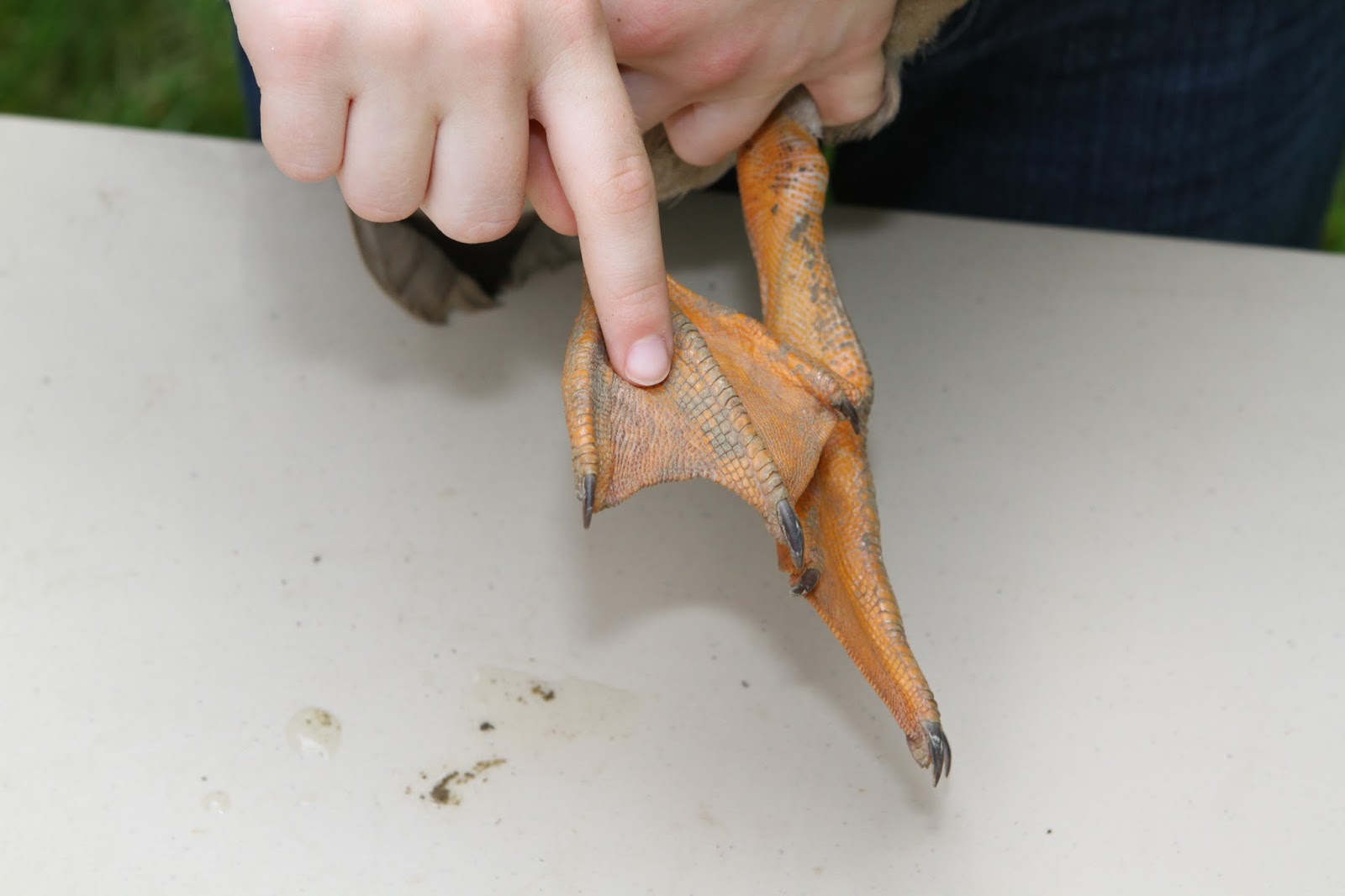
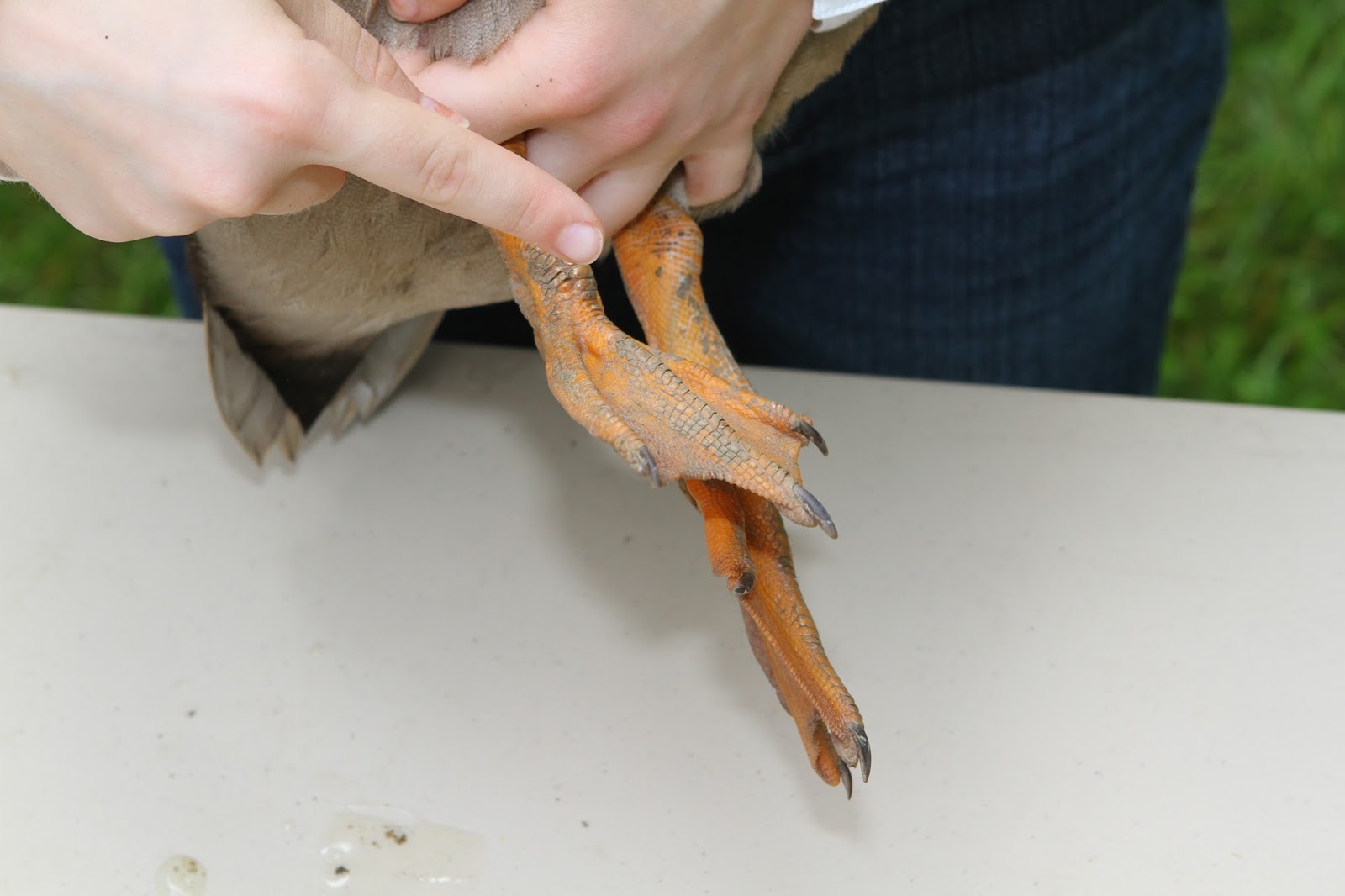
You hold the feet by putting two fingers around each leg as shown and put your thumb
at the top of the leg.

Thursday, June 18, 2015

Northern Cardinals

Male Cardinal
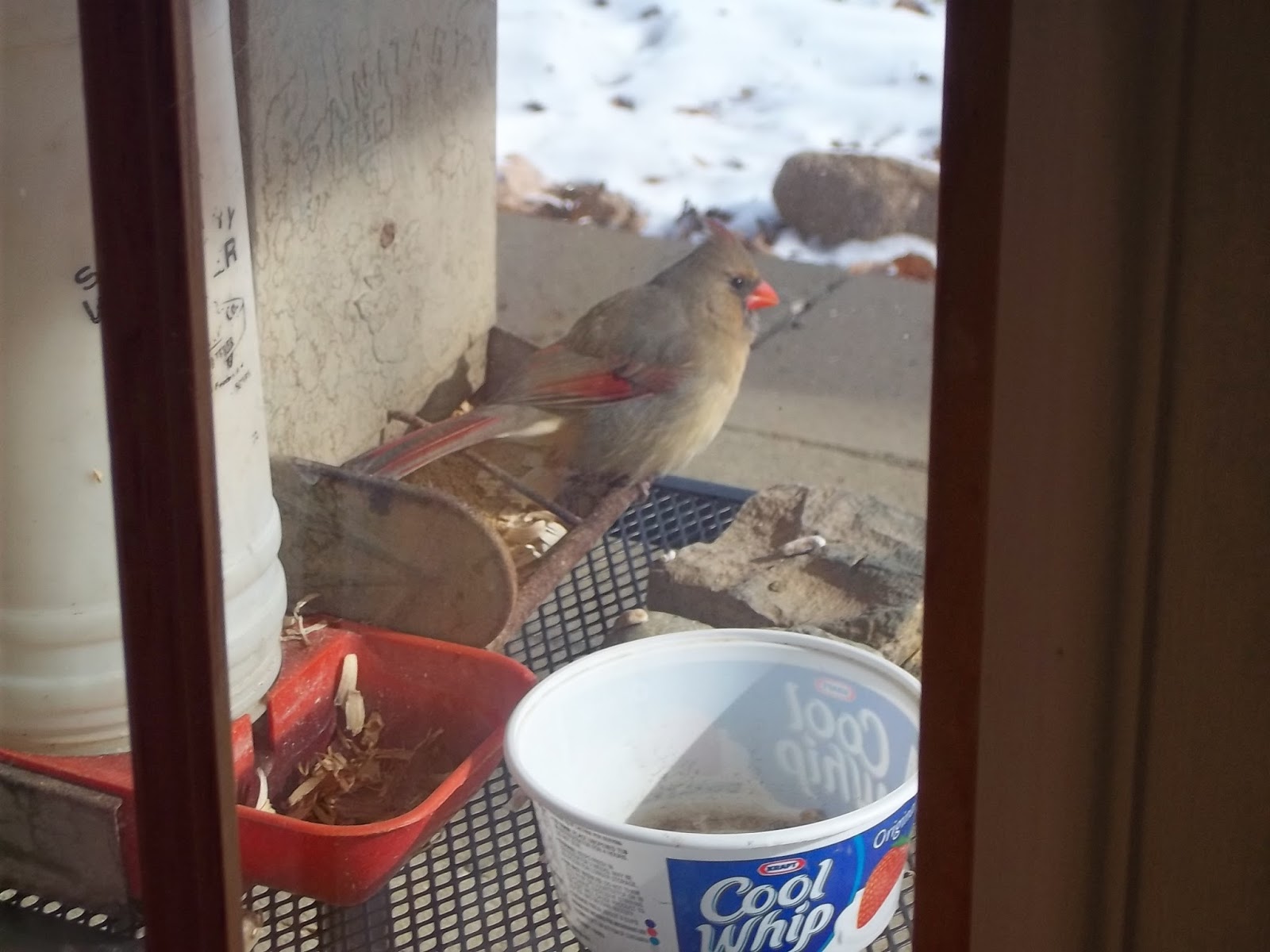
 When we had baby ducks in our basement in January 2014 we got them a different feeder and put the old one outside on our patio. A pair of cardinals found it and discovered that we had left food in it.


Female Cardinal
The male cardinal has a red crest and plumage, a  black head and a pink beak. Female cardinals are tannish-brown with red on wings, tail, and crest. They make nests of     grass and twigs. The female will lay 3 to 4 spotted brown white eggs.
 
 The cardinal is the official bird of seven US states.  It is a very well known bird. The male will defend his territory by fighting off other male birds. The male cardinal will sometimes attack his own reflection in a window, mirror, or anything that he can see his reflection in.


In the picture below you will see a female cardinal, and another bird in the background. I think that  the bird in the background is a cowbird. I was taking a picture of the cardinal and didn't see the other bird, so I decided that it photobomed my picture. Once I saw the bird in my picure, I wanted to know what kind it was. I thought that it looked like a cowbird the most. So a cowbird photobombed my picture of a female cardinal.


A cowbird photobombed my picture


Thursday, June 11, 2015

Bald Eagles

Last year we went to Homosassa Springs, Florda
 Last summer for vacation we took a family trip to Florda. We went to Disney World, Coco Beach, and Homosassa Springs, a Florida state park. At Homosassa Springs we saw lots of animals. The bald eagle was one of many different kinds of birds we saw. These pictures of bald eagles were ones we took when we were there.


 Bald eagles are very reconized birds. They have white necks, heads, and tails, yellow beaks and feet, and the rest is brown. The female will lay one to three white eggs, when she is old enough and is ready to start laying. Male and female eagles are great parents, as great and faithfull partners. They prefer to eat fish.
The bald eagle is one kind of eagle. Eagles in general are a symbol of power and strength, usally depicted fighting a serpent, the symbol of evil. In World War II, the day that the Germans were to begin their air attack on Britain was called Adlertag, or "eagle day." 

The bald eagle is the United States' national bird and is also on the American seal.

Friday, June 5, 2015

My Khaki Campbells

The Khaki Clan
 I was going to show my Khaki Campbells this year at the fair, but I got disappointing news this week that all poultry shows were canceled in the state of Ohio. I might end up showing my Khaki Campbells next year.

Khaki Campbells are a mix of an Indian Runner and a male Rouen. The person who developed the Khaki Campbell was Mrs. Adele Campbell. There are three different kinds of Khaki Campbell's: light,dark, and Khaki. I have dark Khaki Campbell's ,but I just call them Khaki Campbells.

Khaki Campbells weren't developed to be sitters. If a Khaki Campbell does go broody they will only keep it up for a few hours or days, not long enough to hatch eggs. If you want to hatch Khaki Campbell eggs you need to get an incubator. An incubator will keep them warm, so it is like a duck is sitting on the eggs.


The male Dark Khaki Campbells should have a beetle-green head and neck, and a light brown body  with penciling on the feathers. His legs should be orange and his bill a bluish-green.  The female Dark Khaki Campbell should be dark brown on the head and neck, light brown over the shoulders, breast, and flank, with dark brown pencilings on the feathers. Her back and tail are dark brown,her legs are close to her body color, and her bill is slatey brown.

I loved raising my Khaki Campbells and I think that they are very pretty ducks.
A female and male    
The day I got them
First day outside and first bath